Problem
04 · Battery systems · engineering software
Digital Twin — Li-ion Battery Packs
Battery Twin: configurable Li-ion pack simulation and evidence-based CSV telemetry diagnostics. Streamlit is the primary application; a React dashboard is available on Vercel.
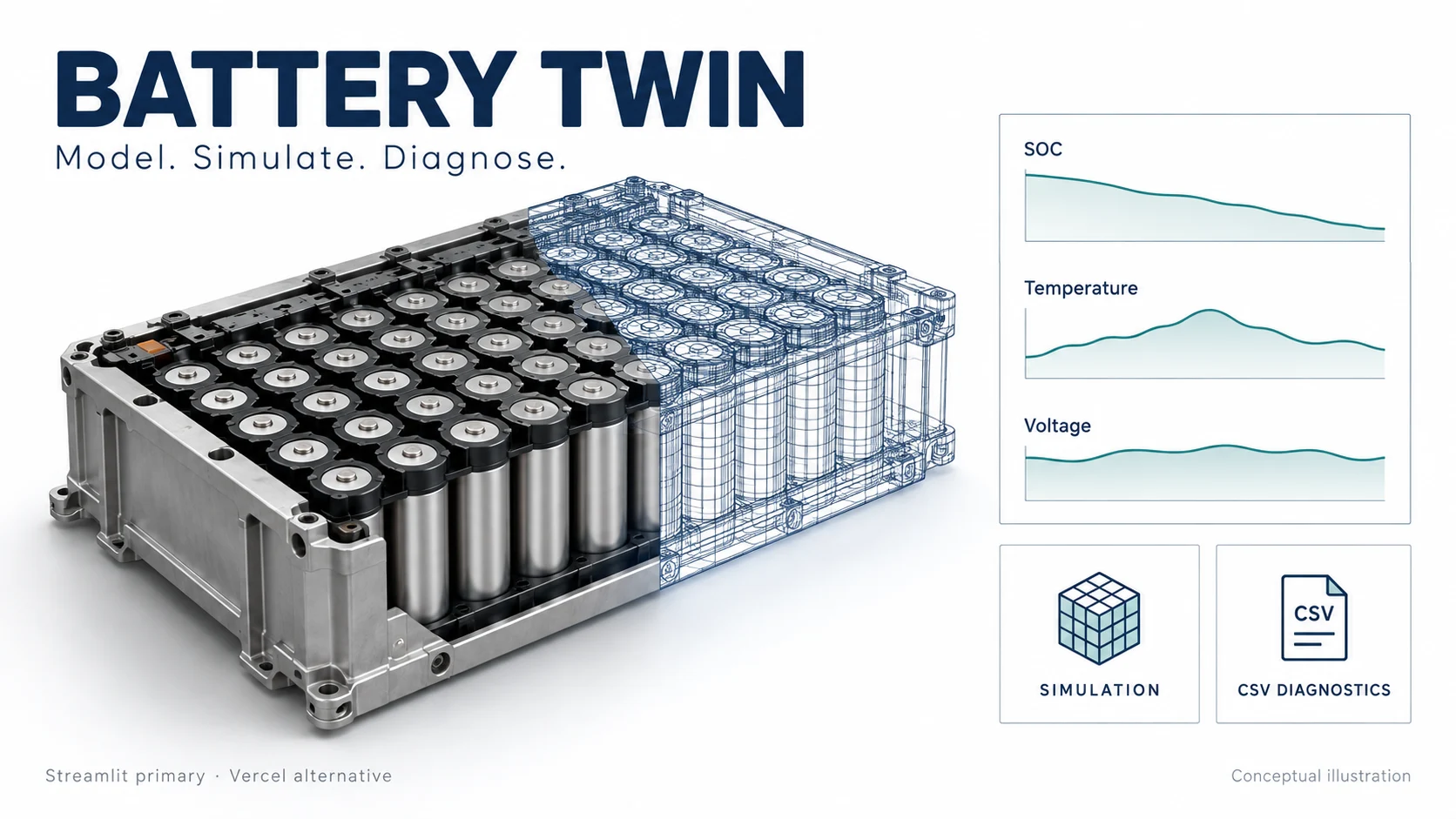
Conceptual Battery Twin illustration: a battery module and its digital representation alongside illustrative monitoring curves. Simulation and imported CSV diagnostics are separate workflows. This is not deployed hardware or an application screenshot.
Solution
For early design studies, compare current profiles and pack configurations with a Thevenin 2RC / thermal model and EKF SOC estimation. For imported CSV data, calculate charge/energy and document gaps or threshold crossings. The report helps engineers choose follow-up measurements; it does not identify a failed cell or authorise vehicle return to service. The square, restrained HMI is inspired by ISA-101, without certification claims.
Build path
- Configure pack topology and compare electrical and thermal scenarios.
- Inspect overview, cells, trends and simulation controls in Streamlit.
- Import telemetry, select the current sign convention, and calculate charge and energy.
- Flag sampling gaps, temperature and cell-voltage spread; export a JSON report with SHA-256 provenance.
Discussion
Validation: 41 Python tests passed. Charge integration was checked on 636 NASA discharge cycles from four laboratory cells (185,721 measurements): mean absolute difference of 0.01303 Ah against capacity labels. This checks numerical consistency, not vehicle qualification or SOC prediction accuracy. SOH requires capacity observations; RUL is a simple trend with at least five observations. No CAN/OBD connection, OEM calibration or universal vehicle diagnosis is claimed.
Reports and links